

I don’t think this has one answer that fits all. The only thing consistent among everyone is that speaking a language is a skill. Skills, no matter what they are, are only learned by a compounding effect of exposure. That means to be good at it you need to practice it as often as possible, even if it is in 5‑minute increments.
The second thing to consider is which Arabic you are learning, which dialect and for what purpose. Learning one dialect for the specific reason of speaking with family members or in‑laws usually gives the fastest progress because of constant exposure: you find yourself in situations where you are forced to communicate, come up with words, and make sentences. But that is not to say the same cannot happen if you are learning Arabic for work or because you live in Dubai and don’t want to spend 20 years here without learning the language. It just means the constant exposure and effort will have to be recreated by you.
Now let me give you some guidelines so you can have a clearer picture. The most success I have seen over the years of teaching conversational Arabic is with learners who started their journey with at least three sessions a week for the first 6–12 months. However, I know that is not doable for everyone with busy schedules. The next best thing, and THE MINIMUM I would recommend for starting, is twice a week for a minimum of 12–18 months to build a solid base. Learners who opted for once a week didn’t reach the level they wanted after one year and were mostly left unmotivated after some time.
If once a week is all you can afford with a tutor, then you need to make sure you get enough practice on your own the rest of the week. Make sure that the next lesson with the tutor is not spent only on revision but on adding new knowledge; a lot of the work will fall on the learner. In my experience it is always better to talk with someone because you are learning a language to talk to people, not just to practice on your own.
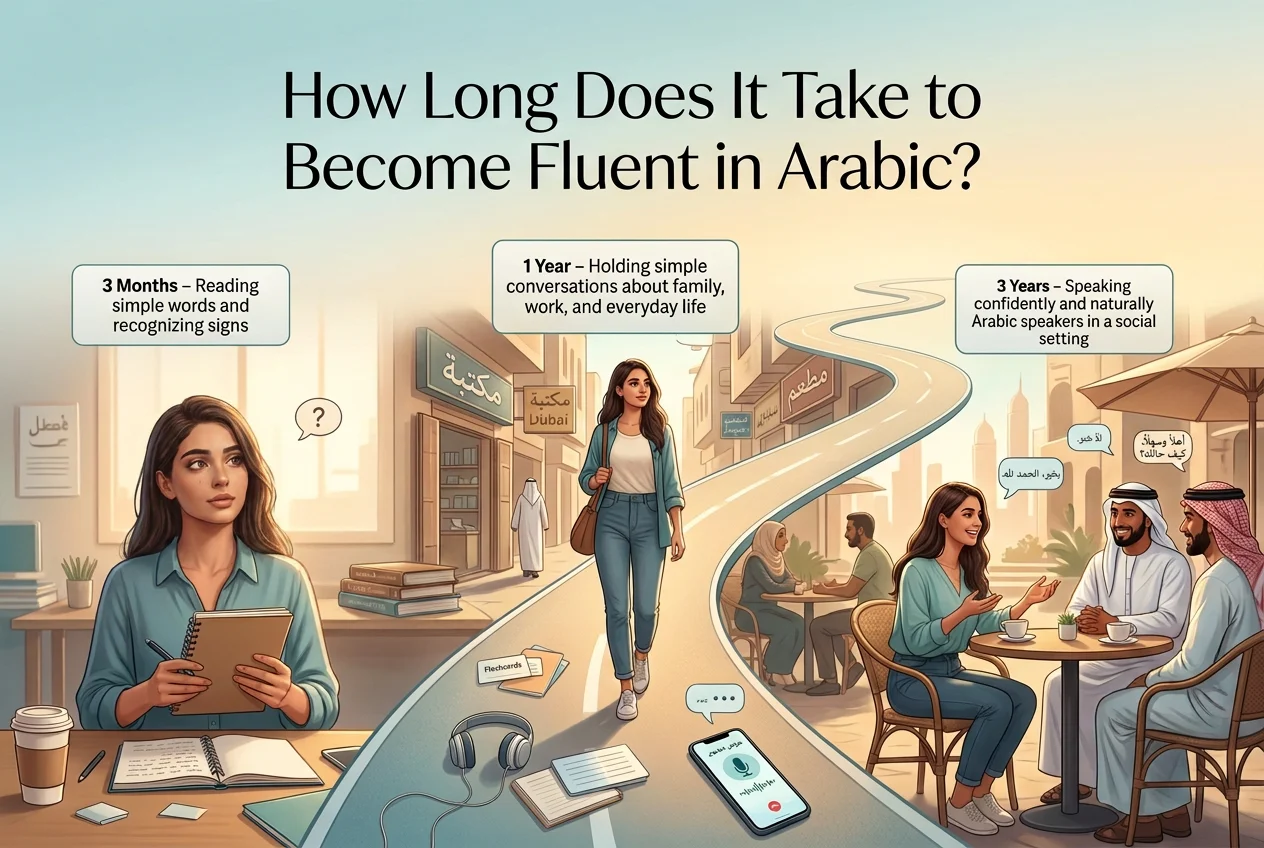
Now that we discussed frequency: the length of time to be able to speak and hold simple conversations, like getting to know someone and talking about family, work, and daily activities, is about 1 year. The understanding part usually comes a bit after. Arabic is spoken in many accents, speeds, and tones, and that takes some getting used to. Learning the skill to understand Arabic speakers will take another year to a year and a half, but it is really the period where you have the most fun. Throughout this time you start to understand people around you and actually engage in conversations instead of feeling the huge block that comes from being able to speak but not understand.
So all in all, 3 years should be a good period to expect to reach a good conversational level. Some people are faster and some are slower. Consistency and frequency always trump everything.

Get a system ready for long vacations and breaks: voice‑note homework, lesson revisions, and materials if you are not able to have lessons. That is the time most peo
ple feel demotivated after a vacation and keep delaying the restart of lessons in fear of how much they’ve forgotten. I usually prepare my students for vacations, give them materials, keep chatting with them during the break to force them to speak Arabic, and send voice notes they need to transcribe, many different ways to fit your life and help you stay on track whether you have 5 minutes or 30.
This is what you need to know in terms of timelines for learning the language. In the end, it is not different from learning any other language or skill where you want to achieve a good level. Now get to learning, there is no need to wait for Monday or the new year.


