
- Blog
Where to Learn Arabic in Dubai: Institutes vs. Private Tutors vs. Online
- 7 min read
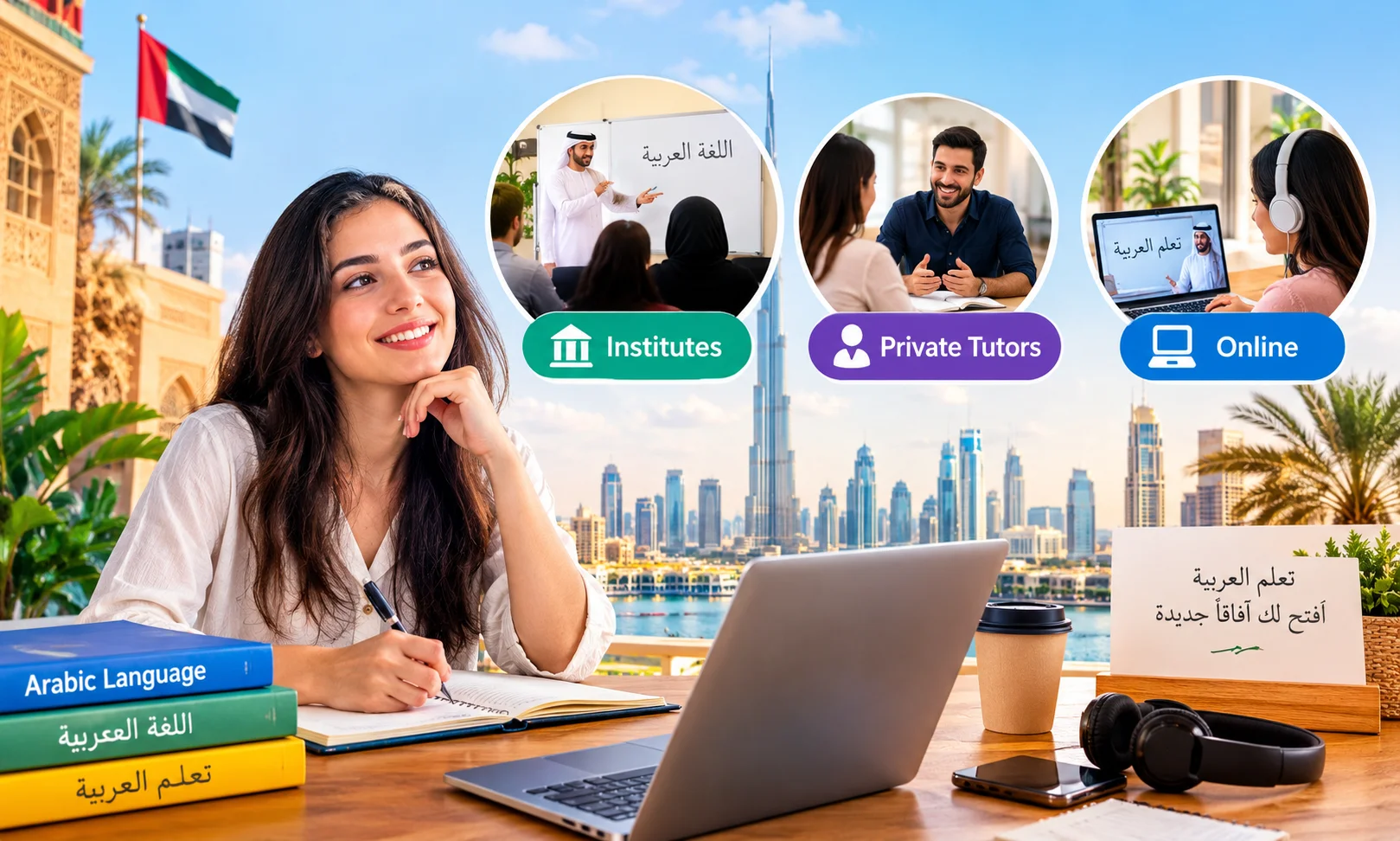
Learning Arabic in Dubai is easier than most people think, but choosing how to learn it is the real decision.
You can join a language institute, hire a private tutor, or study online. Each path works differently depending on your schedule, budget, and goals.
This guide breaks down all three options in simple terms, so you can pick the one that actually fits your life.
Quick Answer: Which Option Is Best for Learning Arabic in Dubai?
Language institutes suit people who want structure, certificates, and classroom interaction. Private tutors work best if you want fast, personalized progress in conversational Arabic.
Online learning is ideal for busy professionals, expats, and parents who need flexible timing without commuting across the city.
Most learners in Dubai now combine private tutoring with online sessions since it offers the best mix of personal attention and convenience.
Option 1: Language Institutes in Dubai
Language institutes are the traditional route. You join a fixed class schedule with other students and follow a structured curriculum.
Most institutes teach Modern Standard Arabic (MSA) first, since it’s the formal, grammar-based version used in writing, media, and academic settings.
Pros of Institutes
- Structured syllabus with clear levels
- Group learning environment and peer motivation
- Recognized certificates for some programs
- Fixed class timings help build discipline
Cons of Institutes
- Large class sizes mean less individual attention
- Fixed schedules don’t suit busy professionals
- Focus on MSA, not everyday spoken dialects
- Slower progress if your classmates learn at a different pace
Institutes work well if you enjoy classroom settings and don’t mind a slower, formal approach to grammar and reading.
Option 2: Private Arabic Tutors in Dubai
A private Arabic tutor gives you one-on-one lessons built entirely around your goals, pace, and preferred dialect.
This is the fastest way to become conversational, especially if you want to focus on Levantine, Emirati, or Egyptian Arabic instead of only formal grammar.
Private tutoring in Dubai can happen online, in person, or as a blend of both, depending on what the tutor offers.
Pros of Private Tutors
- Fully personalized lessons based on your level
- Faster progress since there’s no group pace to follow
- Flexible scheduling around work or family life
- Choice of dialect: Levantine, Emirati, Egyptian, or MSA
- Real conversation practice from lesson one
Cons of Private Tutors
- Costs more per hour than group institute classes
- Quality depends heavily on the individual tutor’s experience
- No classmates, so less peer-driven motivation
Private tutoring suits people who want to speak Arabic confidently within months, not years, and who value personal attention.
Coaches like Sabrine Guerbaya, who teach conversational Arabic across Levantine, Emirati, and Egyptian dialects, are a good example of this personalized approach in Dubai.
Option 3: Learning Arabic Online
Online Arabic learning has grown fast in Dubai, especially among expats juggling work, family, and long commutes across the city.
You can join live sessions on Zoom, follow self-paced courses, or use downloadable materials like worksheets, audio lessons, and vocabulary packs.
Pros of Online Learning
- Learn from anywhere in Dubai, or outside the UAE entirely
- No commute, so lessons fit tighter schedules
- Often more affordable than in-person institutes
- Access to recordings, worksheets, and digital resources
- Easy to combine with a private tutor for live practice
Cons of Online Learning
- Requires self-discipline to stay consistent
- Less immersive than in-person, face-to-face learning
- Technical issues can occasionally interrupt sessions
Online learning works especially well when paired with live one-on-one sessions, since you get flexibility and personal coaching together.
Institutes vs. Private Tutors vs. Online: Quick Comparison
| Factor | Language Institutes | Private Tutors | Online Learning |
| Best for | Structured, formal learning | Fast, personalized fluency | Busy schedules, flexibility |
| Class type | Group | One-on-one | One-on-one or self-paced |
| Dialect focus | Mostly MSA | Any dialect (Levantine, Emirati, Egyptian, MSA) | Depends on tutor or course |
| Schedule flexibility | Low | High | Very high |
| Pace | Set by class average | Set by you | Set by you |
| Typical cost | Moderate | Higher per hour | Moderate to affordable |
| Certification | Sometimes available | Rarely, but goal-based progress | Varies by provider |
This table gives you a quick snapshot, but your final choice should depend on your goals, not just the price.
Which Option Fits Your Goals?
If you want a certificate for academic or visa purposes, an institute focused on MSA is usually the right call.
If you want to speak Arabic confidently at work, with neighbors, or while traveling across the UAE, a private tutor gets you there faster.
If your schedule is unpredictable or you travel often, online lessons with a private coach give you the flexibility to stay consistent.
Many Arabic learners in Dubai actually start online with a private tutor and add in-person sessions later, once their confidence grows.
Which Arabic Dialect Should You Learn in Dubai?
This is a common question for new learners, and the answer depends on who you talk to most.
Emirati Arabic: Best if you work closely with local Emiratis or government entities.
Levantine Arabic: Widely understood across the Arab world and common in Dubai’s expat community.
Egyptian Arabic: Useful since Egyptian media, films, and music are widely consumed across the region.
Modern Standard Arabic (MSA): Essential for reading, writing, and formal or academic communication.
A good private tutor will usually help you choose based on your daily environment, not just personal preference.
Why Dubai Is a Great Place to Learn Arabic
Dubai is home to a mix of Emirati, Levantine, and Egyptian Arabic speakers, so you hear different dialects every day.
This makes it one of the easiest cities in the world to practice conversational Arabic outside the classroom, whether at work, in taxis, or at the souk.
Many expats living in the UAE also learn Arabic for career growth, since bilingual professionals are often preferred in government and business roles.
Whether you’re a parent, an adult professional, or someone relocating to the UAE, Dubai gives you real chances to practice daily.
How a Private Coach Like Sabrine Guerbaya Can Help
Sabrine Guerbaya is an Arabic language coach based in Dubai, teaching conversational Arabic across Levantine, Emirati, and Egyptian dialects, alongside MSA for reading and writing.
Lessons are available online or in person for kids, adults, and companies, with sessions delivered live over Zoom and synced to your calendar.
This kind of personalized coaching blends the structure of an institute with the flexibility of online learning, without the wait of a fixed class schedule.
If you want a plan built around your goals, a free consultation is usually the easiest first step before committing to a package.
Frequently Asked Questions
Is it better to learn Arabic with a private tutor or at an institute in Dubai?
A private tutor is better if you want fast, personalized progress in conversational Arabic. Institutes suit learners who prefer structured group classes and formal grammar-based learning.
Can I learn Arabic online and still become fluent?
Yes, online Arabic learning can lead to fluency, especially with live one-on-one sessions. Combining online lessons with a private tutor gives the best results for most learners.
Which Arabic dialect should I learn first in Dubai?
Most learners in Dubai start with Levantine or Emirati Arabic, since both are widely spoken in daily life. Your choice should match who you talk to most often.
How long does it take to become conversational in Arabic?
Most learners reach basic conversational ability within three to six months with consistent private lessons. Progress depends on practice frequency, dialect focus, and prior language experience.
Do I need to learn Modern Standard Arabic (MSA) to speak Arabic in Dubai?
No, MSA isn’t required for everyday conversation in Dubai. It’s mainly useful for reading, writing, and formal settings, while spoken dialects handle daily communication.
Recent posts


You may also like

- Blog
- 9 min read
Most offices in Dubai run on English. Emails, reports, and

- Blog
- 14–16 min read
Arabic dialects differ mainly in pronunciation, vocabulary, grammar and everyday

- Blog
- 13–15 min read
To become conversational in Arabic faster, practice the way memory