

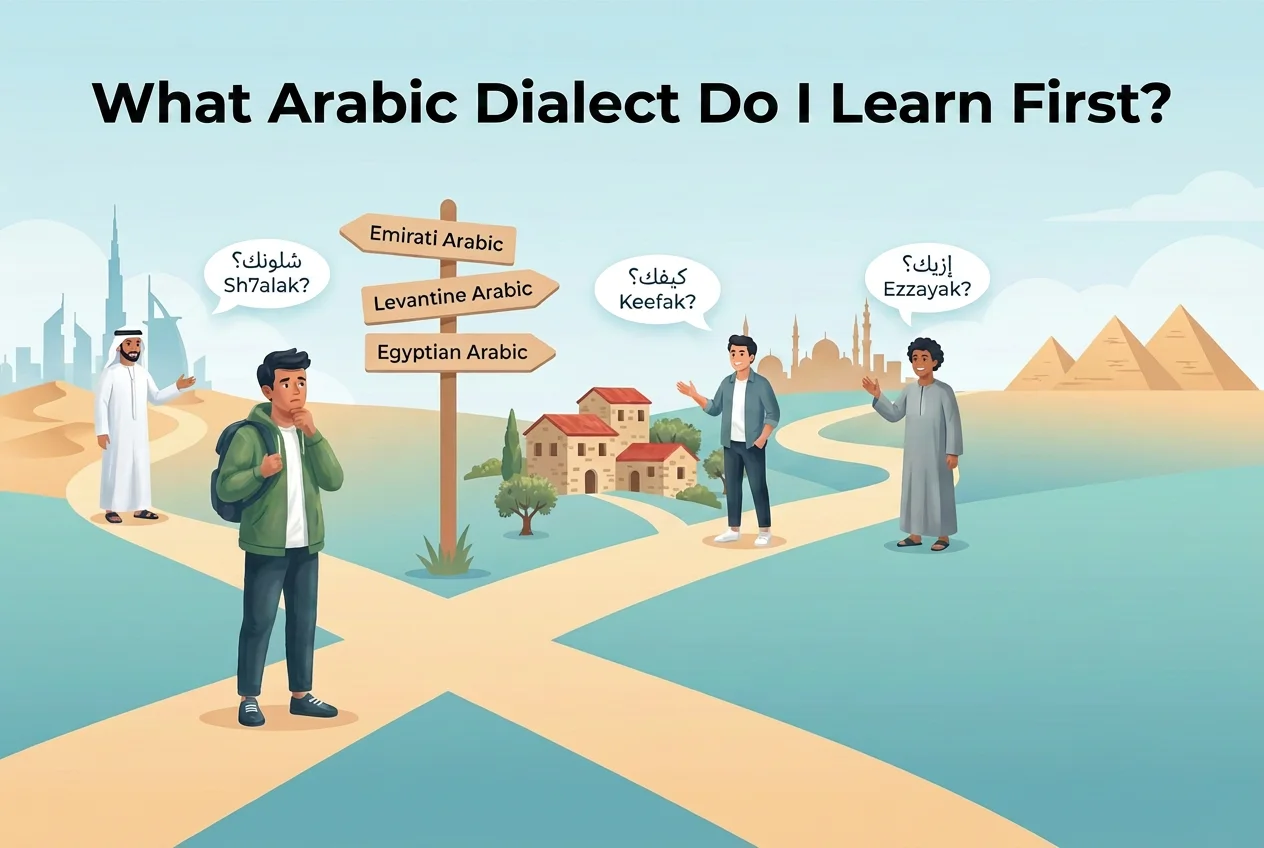
To understand which Arabic dialect you should learn first depends a lot on where you live and who you socialize with, that’s usually the reason you became interested in the first place. In my experience, there are two common reasons people start thinking about learning Arabic.
Your partner is from an Arabic country. You want to communicate with their family and friends and possibly with your kids one day. In this case, learning your partner’s dialect is the best way to go.
You live in a multicultural city like Dubai, where every day you meet people from many Arabic countries: Emiratis, Jordanians, Egyptians, etc. You say, “I want to learn Arabic.” This is doable, but you need to understand what you are getting into.
Your journey will be divided into two main skills: speaking and understanding.
If you decide to learn Emirati Arabic because you live in the UAE, you will cover the speaking part. But you may face a big hurdle when socializing in a group with an Egyptian, a Lebanese, and an Emirati. They will often understand each other, but you might understand only the Emirati (or whoever speaks your chosen dialect). So, to keep it short: you must also focus on the listening/understanding skill for other dialects.
 I find that if you mainly focus on Emirati and Levantine dialects, you will cover a large portion of both speaking and listening. Emirati covers much of the Gulf jargon, and Levantine covers Jordan, Lebanon, Syria, and Palestine.
Egyptian is also useful, but it mostly applies to Egypt. I usually recommend it later unless your main purpose is to speak with Egyptian relatives or you live in Egypt.


