

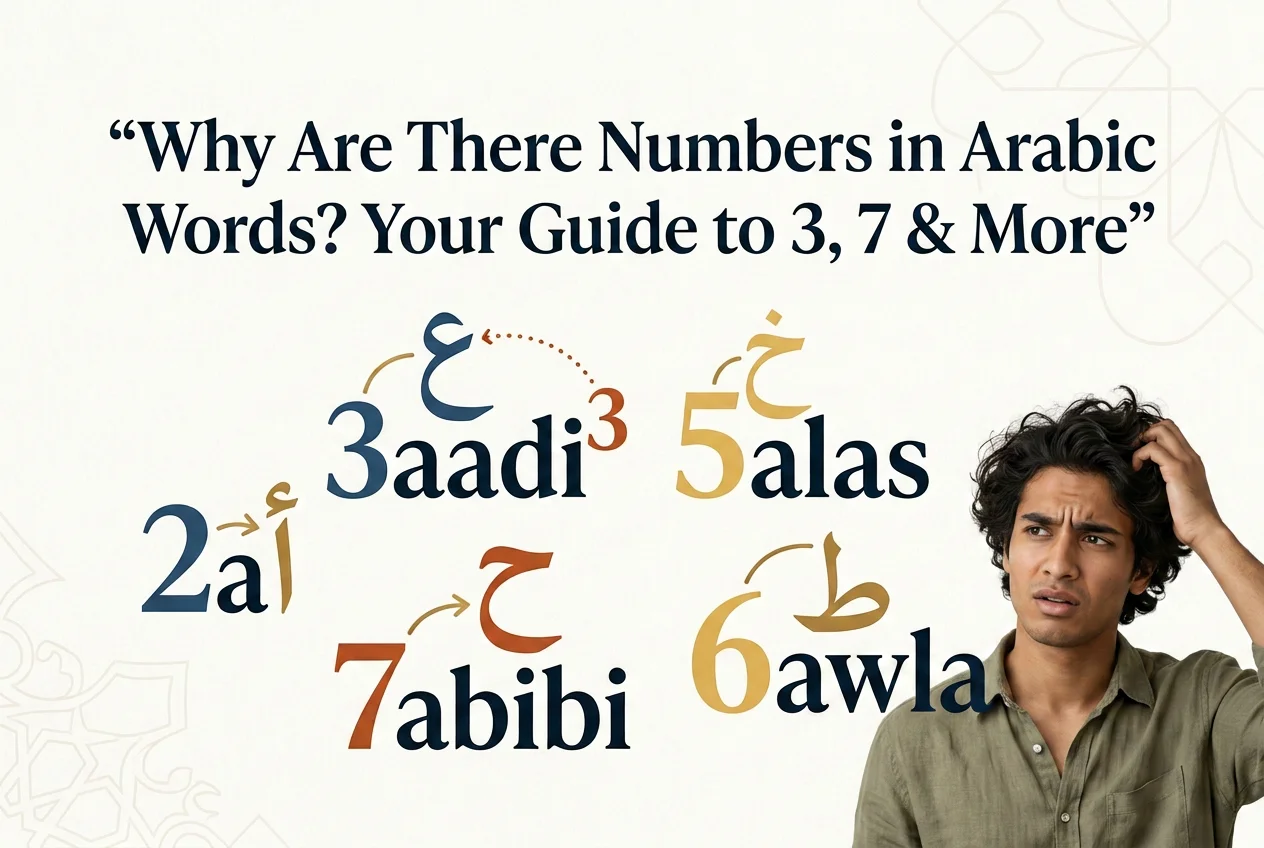
So you might have seen a lot of words like “3aadi” or “7abibi”, and you are wondering: what is number 3 and number 7 doing in a word?
I am going to explain all of that for you so that you never get confused again about this.
To start, we need to know that the Arabic language has 28 letters, and all of them are practically consonants. That means none of these letters is “o,” “u,” “i,” etc.
English has 26 letters, including consonants. So, if the math works right, there are sounds that exist in Arabic and don’t exist in English.
In fact, in the Arabic language and alphabet, we typically have some consonants that are very similar to each other, including heavier and lighter versions of certain sounds. Let us look at some of them.
In Arabic, we have 2 versions of the letter T: a soft one and a hard one.
The soft T is usually written with the normal English letter T. Example: tamreen = exercise. So if I wanted to write the Arabic word using English letters, I would use the normal T from English.
However, we also have a heavy T, and to represent the difference using the English alphabet — and since the letter T is already taken to represent the normal T, we use the number 6.
So, to write the soft T, you simply use T. To write the hard T, you use 6.
For example, the word table in Arabic is tawla, but because in reality the T is supposed to be a lot harsher, you might see it written as 6awla.
I know visually this takes some getting used to.
So here is what I will do. You will see in the following list all of the numbers used in Arabic transliteration when using the English alphabet.
After that, I will tell you what are really the major 3 numbers you need to know, and the rest you can just add as a bonus, only if you really want to.
| Number | Arabic letter | Name of the letter | Example | Meaning |
|---|---|---|---|---|
| 2 | ء / أ | alif / hamza | su2al (soo-aal) | question |
| 3 | ع | 3ayn | 3arabi | Arabic |
| 3′ | غ | ghayn | 3’ali (ghali) | expensive |
| 5 | خ | kh | 5alas (khalas) | finished |
| 6 | ط | ṭ | 6areeq (Tareeq) | road |
| 6′ | ظ | ẓ | 6’olm (Dholm) | injustice |
| 7 | ح | ḥ | 7abibi | my darling |
| 9 | ق | q | 9alb | heart |
| 9′ | ض | ḍ | 9’aroori (darooree) | necessary |
OK, the hard part is over. As I said, you don’t really need to use allllll of these.
Here is what you really need to know.
Number 2
2 usually represents the hamza (ء), not simply the letter A.
And what you need to know is that A can be a vowel that dictates the sound of the consonant before it, same as in ba: the a just acts as the vowel sound of the letter b, so that you say ba instead of be.
When we use 2, it is because we want to show that there is a hamza, a separate sound, and it should not simply be read as part of the consonant before it.
For example, if you see sual, you will probably say something like “soowal” or read it as one flowing sound.
But if you see su2al, you will read it as two parts:
su + al → su-al
So in the case of the 2, you can use it to show that there is a break between the sounds. You can also sometimes see a – or an ‘ used for the same purpose.
Then number 3
This one is a must-know.
It is a staple sound in the Arabic language. It is also the sound that makes everyone choke when trying to say it!
The 3 represents the Arabic letter ع (3ayn). It is a sound that does not exist in English at all, so we will need to learn it.
You have to pronounce it by tightening your throat muscles while trying to say an a sound.
Also, it is not a vowel, remember!
Then we move to 7
Another major marker of the Arabic language.
The 7 represents ح, which kind of sounds like H, but it is not the same sound.
We do have a normal H in Arabic, which you can pronounce like the H in hello.
But we also have 7, which is a much stronger, more throat-dominating H sound.
And it is used in very common words like 7abibi and names like A7med.
With only these 3 numbers: 2, 3 and 7, you can already manage quite well.
The rest of the numbers are not 100% mandatory and can easily be replaced with normal English letters.
For example, for the Arabic Q sound, you don’t need to use the number 9. Most commonly, we simply use the letter Q to represent it.
It is important, though, to know that Q and K can change the whole meaning of a word:
kalb = dog
qalb = heart
Then, for the number 5, you can easily replace it with kh.
So instead of 5alas, you can write khalas.
Easy peasy.
For the 3′, you can use gh. So instead of 3’alee for expensive, just write ghalee.
For 6′, you can simply use dh or z, depending on the dialect and the transliteration system you are using.
For 9′, you will also see different ways of writing it, such as d or dh, depending on the dialect and the person’s preferred transliteration.
 To be honest, for the duplicate or similar consonants: t, d, s and dh, it is quite flexible because the word will kind of sound the same anyway, especially once you are already familiar with Arabic.
But 3 and 7 are a must-know, because they represent sounds that you really cannot replace properly with a normal English letter.
And for 2, you can eventually eliminate it once you learn how to recognize and pronounce the hamza in the middle of a word.
So there you go!
You don’t need to memorize a whole new alphabet just because you see numbers in Arabic words.
Start with 2, 3 and 7. Once you get comfortable with those, the rest is just a bonus.
Share this with a friend of yours who is learning Arabic!
And send me questions about complicated words, if you are wondering whether you need to use a number or not, I am happy to answer.
You can also download the number-to-letter conversion table for free to keep it handy.
Ciao!


