

Arabic is a very rich, ancient language.
The Arabic that is common across all countries is MSA, Modern Standard Arabic. It is taught in schools and used in official settings like the news, contracts, emails, and courts, but not in day-to-day conversations. It is also the written language in Arabic books and any printed material.
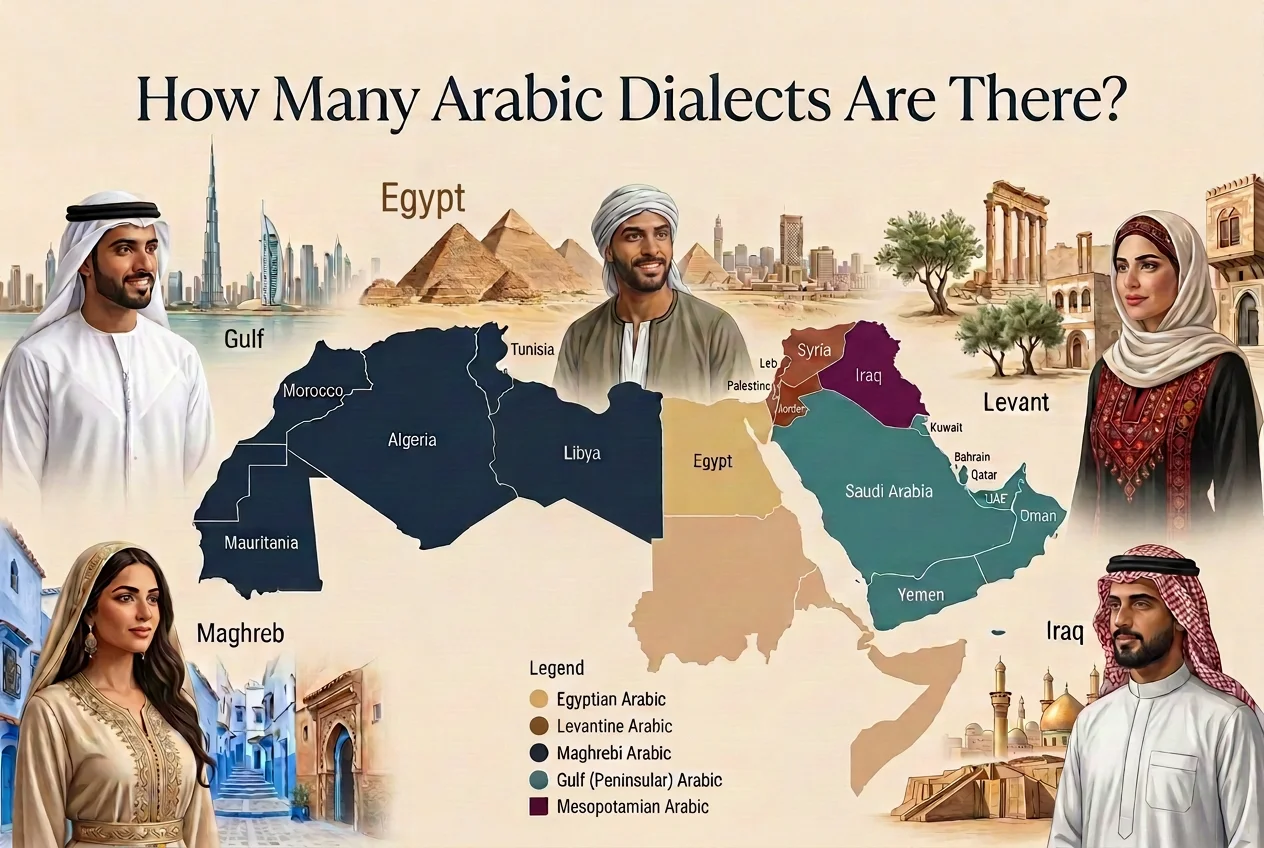
There are 22 Arabic-speaking countries in the world. From these 22 countries come many, and I mean many, dialects: around 25 widely recognized regional varieties. That means each country (and often regions inside a country) has a specific dialect with differences from others. We can group them into major groups because some dialects have more in common with certain others than with the rest.
1) Egyptian Arabic: Spoken in Egypt and widely understood due to media.
2) Levantine Arabic: Spoken in Lebanon, Syria, Palestine, and Jordan.
3) Maghrebi Arabic (North Africa): Spoken in Morocco, Algeria, Tunisia, and Mauritania.
4) Peninsular (Gulf) Arabic: Spoken across Saudi Arabia, UAE, Qatar, Kuwait, Oman, Bahrain, and Yemen.
5) Mesopotamian Arabic: Spoken primarily in Iraq.
North African Arabic (Maghrebi) is one of the hardest to follow for speakers from other regions because it mixes influences from many ancient languages and later contacts: Berber, Byzantine, Ottoman, French, Italian, and Spanish. Speakers from this region sometimes even have difficulty understanding each other, but they still communicate with speakers of other Arabic dialects.
Egyptian Arabic, although mainly spoken in Egypt, is very prevalent because of Egyptian cinema and music. Most Arabic speakers are familiar with it from films and songs. Levantine is the second most understood dialect; in the last 10–20 years it has become very popular through series and music. Many dubbed foreign shows use Levantine Arabic.
Gulf dialects are increasingly useful as the UAE and other Gulf countries grow globally. Other Arabic speakers usually need some exposure to understand Gulf speech, not because it’s inherently more difficult, but because the accent can be stronger.
 All in all, most Arabic speakers can communicate with each other. A Jordanian, an Emirati, and an Egyptian can hold a conversation, each speaking their own dialect and understanding the others. That is also what you want to achieve as a learner.
I don’t think any learner should limit themselves to one dialect. You can choose to speak one, but you should definitely try to understand them all (at least 2 groups) . This is what I do and what I teach.
I wrote a whole book about it. Have a look at my free material or schedule a call with me and we can discuss how your learning journey should look.


